Crypto Market Making
Token Liquidity

Current Issues and Solutions in Crypto Market Making

How the new standard of market making, Market Making as a Service (MMaaS), is fixing the problems of the traditional proprietary market-making model.

January 10, 2023

What market making is in crypto

The concept of market making is deceptively simple — and often misunderstood.

Being an essential part of any financial market, the definitions, explanations, and examples of market making are ubiquitous, see for example Investopedia, Wikipedia, The Tokenist, or The Balance.

Essentially, market makers are actors who commit to stand on both the selling side as well as the buying side of the market. Too often, there are not enough buy (bid) and sell (offer or ask) — i.e. market liquidity is low. Market makers provide liquidity to make it easier and cost-effective for everyone to buy and sell an asset at any time.

Digital asset market making is even more complex than in traditional finance due to the nature of the underlyings and the market structures.

Gas fees and transaction costs, decentralization and market fragmentation make it difficult to track prices and make informed decisions: hundreds of disparate centralized and decentralized exchanges alongside incompatible blockchains need to be bridged. Underdeveloped regulation and business practices contribute to crypto’s volatility on top of the lack of readability of the assets themselves. Unlike listed companies, crypto assets have more complex business models and do not provide audited quarterly results.

On this ocean of uncertainty, more than in any other markets, tokens need liquidity support from market making.

Liquidity is always difficult to come by. If an asset’s market remains illiquid for too long, the token’s value will suffer, also making it susceptible to market manipulations.  Such an asset is unlikely to be listed (or stay listed) on high-tier centralized exchanges leading to a self-fulfilling prophecy of price deterioration over time. Ultimately, an entire project can go under with the price drop of its token.

This is why exchanges — including traditional stock exchanges — rely on market makers. In crypto, centralized exchanges usually obligate token issuers to contract one.

First-generation market making: proprietary trading in brief

Most market makers are proprietary traders, often trading firms.

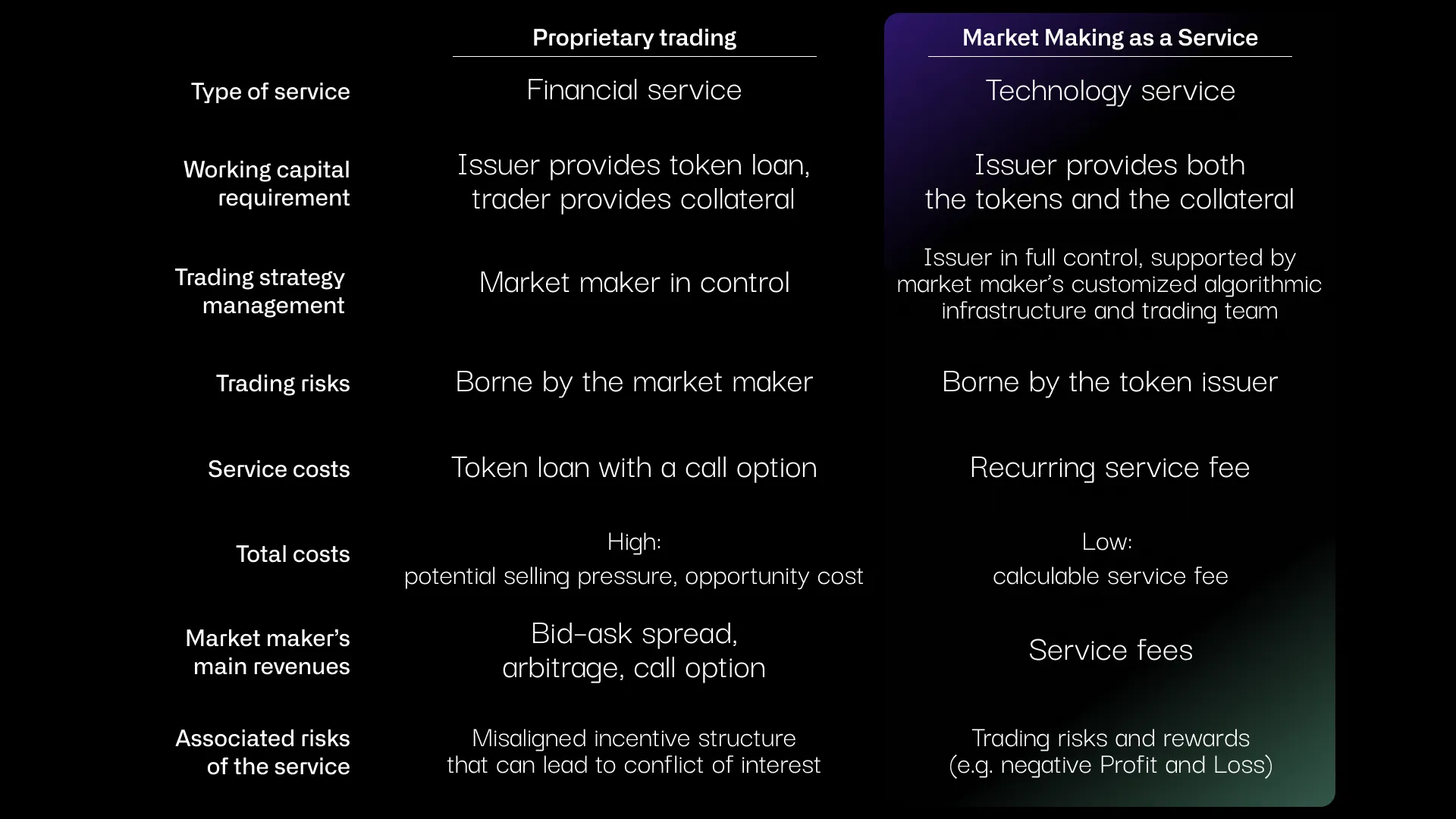
They essentially take an interest-free loan” from the token issuer to get the tokens to be traded. Then, the proprietary market maker adds its own funds (usually in stablecoins or ETH) to market make — to be on both bid and ask sides of the token market.

Most proprietary traders offer their services for free — or so it seems. They make profits in three ways:

  • on the bid–ask spread — by quoting prices that are higher on the sell side than the buy side, the market-maker can generate income, often called Profits and Losses” (P&L or PnL) just by buying and selling the asset throughout the day;
  • on arbitrage — the occasional price differences among different exchanges; and
  • exercising their call option — the contractual right to buy the borrowed tokens at a predetermined price at basically any time — and selling the tokens.

The problems of proprietary market making

Agreements between token issuers and proprietary traders include these call options which constitute a severe risk of conflict of interest.

The call option incentivizes token price increase — so that the proprietary trader can exercise its call option when the token’s market price rises above the predetermined contractual price. This way, it can make sizable profits on the tokens by selling them on the market.

After riding the wave higher and higher, the token’s market price might nosedive, and the token project loses many tokens and value. This destroys the trust and confidence that the project and the community has worked so hard to build.

In the proprietary market-making framework, issuers are at risk of losing control over a significant portion of their token’s supply. This is because proprietary traders’ activities are often a black box. Token issuers need to give them the benefit of the doubt, trust them to make the right calls and resist these bad instincts.

This is exactly the risk that blockchain was meant to eliminate. It was supposed to be a trustless technology.

These massive issues in market-making today do not even include gray areas” and illicit practices like insider trading or wash trading, creating fake trading volumes.

Market makers are not supposed to trade with themselves” or falsify transactions — but carry out actual buy and sell orders, help investors and the community exchange assets at fair prices.

In addition, being driven by their own P&L, market-makers have a tendency to be highly risk-averse during extreme volatility events. This means that they reduce or remove their liquidity at times when projects need liquidity the most.

Finally, proprietary trading as a business model is inherently unscalable. In crypto, a large portion of the profits of trading firms come from the exercise of the call options and the subsequent sale of the associated token. This means that market-makers assess projects on a case-by-case basis, betting on whether or not they could expect to call their option. In this sense, proprietary market-makers in crypto are more similar to venture capital than to quantitative trading firms. This incentive structure ultimately encourages pump and dumps — ultimately damaging the outlook of a token.

By being financially incentivized by their own P&L, proprietary traders often give preference to their own interests.

This is why we need to reinvent market-making. It must be transparent, scalable, and asset-agnostic — guaranteeing a full alignment of interests between token projects and the firm in charge of managing the liquidity.

The new standard for market making: Market Making as a Service (MMaaS) in brief

MMaaS was developed specifically to decrease the innate risks of the old, first-generation model of market-making, to make good on its original promise: ease token issuers’ burdens and build sustainable markets.

In contrast to proprietary trading, MMaaS does not involve a token loan. It is not even a financial service — rather, a technology service; similar to a software as a service” solution. Strictly speaking, it does not provide liquidity, but a liquidity management solution.

Under this model, it is the token issuer who provides both the collateral as well as the tokens to market make for. The token project can choose and set the market-making strategy, too. Hence what token issuers get, is the service itself: access to the trading infrastructure as well as the support of the sales and trading teams of the MMaaS provider.

Flowdesk’s sustainable and compliant solution

Flowdesk has developed a fully compliant trading infrastructure and platform that allows token issuers to build and manage their liquidity. Its MMaaS platform is supported by a trading and sales team available to token projects 24/7 all around the globe.

The platform’s live dashboards allow clients to monitor their funds in Flowdesk’s custody or on exchanges, trades, orders, and everything related to their market-making operations in real time. This full transparency gives control back into the hands of blockchain projects, their communities, founders, and teams. It is always the token issuers who make the call, enabling them to adjust their trading strategy anytime.

Flowdesk’s strict compliance with legal regulations, its internal policies, due diligence processes, as well as its legal team are set up to enhance the safety of its clients. It prevents insider trading and other conflicts of interest. Hence Flowdesk’s MMaaS ensures that trading is operated in the token projects’ best interests. All their assets remain secure, and they are used solely for the purposes they choose.

This is how Flowdesk can provide non-directional, yet flexible market making: fair, genuine market prices to both investors and holders anytime they need it.
loading=auto

MMaaS is designed to be scalable, fair, and trustless — some of the best of the qualities that blockchain technology represents. At Flowdesk, the model’s strengths are combined with prudence:

  • strict adherence to legal regulations,
  • internal policies on conflict of interest,
  • focus on IT security, and
  • conservative risk management strategies.

Flowdesk’s full transparency provides a trustless service to clients. The aligned interests between the MMaaS provider and its clients ensure fairness — it does not take chances with clients’ assets, only support them in their journeys. And since Flowdesk does not use its own capital for trading, it has built a scalable business model. Flowdesk’s solution is designed to be sustainable, and contribute to the safety and health of the digital asset ecosystem and markets.

More than just a market maker: an all-in-one platform for all digital asset business needs

Flowdesk recognizes that web3 projects need reliable partners at every stage of their journeys — not only in market making.

Hence it does not only accompany blockchain projects on exchanges. Flowdesk has created a full-scale, all-in-one, globally compliant platform — a one-stop shop for all blockchain service needs. Flowdesk complements its market-making with brokerage services; secure custody; as well as treasury management solutions.

All these are designed to ease the burdens of web3 innovators. This is why Flowdesk is working together with trusted partners: infrastructure connecting centralized exchanges, blockchains, custodian and third-party service providers to suit token issuers’ needs.

Flowdesk delivers a comprehensive, overarching set of solutions to help builders and their communities focus on what they do best: creating a more efficient, equitable, and fairer tokenized economy for all.

You might also like

2025 Year in Review: Crypto Credit Markets
January 7, 2026

2025 Year in Review: Crypto Credit Markets

Explore our comprehensive analysis of the crypto credit landscape throughout 2025, including major developments and trends in both OTC and DeFi lending markets.

Crypto Credit Markets
DeFi
Market Update - April 17th, 2025
April 17, 2025

Market Update - April 17th, 2025

This week in crypto was notably quieter than last as markets continue to digest tariff and macro updates. Liquidity conditions in the order books improved across exchanges, and without major headline catalysts, activity levels returned to a more measured, tactical rhythm.

Crypto Market Trends
Digital Asset Markets
Crypto Market Making: Retainer vs. Loan / Call Model
October 29, 2024

Crypto Market Making: Retainer vs. Loan / Call Model

Explore the role of market makers in the crypto world and discover key models to ensure token liquidity and price stability. This guide helps token issuers evaluate strategies and ask the right questions to make informed market-making decisions.

Crypto Market Making
Token Liquidity
Decentralized Exchanges Meet Centralized Models
July 4, 2023

Decentralized Exchanges Meet Centralized Models

In a CLOB, all orders are pooled together and matched based on price and time priority. This model is the standard in traditional financial exchanges and many centralized crypto exchanges. Traditionally, DEXs have utilized different models for trading. Now, we're seeing a trend where some DEXs are adopting the CLOB model. This is the Rise of CLOB-like models in crypto trading.

DeFi Infrastructure
Onchain Liquidity
Intro to Crypto Market Making
June 27, 2023

Intro to Crypto Market Making

Delve deep into the world of crypto market making: its importance, how it works, and the strategies employed by market makers to ensure liquidity in the cryptocurrency market.

Crypto Market Making
Order Book Liquidity
Infrastructure to Define Tomorrow’s Finance
June 5, 2023

Infrastructure to Define Tomorrow’s Finance

Flowdesk is an infrastructure provider first. It uses cloud computing together with open-source solutions to provide exceptional service to digital asset issuers.

Institutional Crypto
DeFi Infrastructure
How Projects Can Select the Right Market-Making Model
May 1, 2023

How Projects Can Select the Right Market-Making Model

Besides their incentive structures, the key difference between the two models is the working capital requirements, the funds needed to start market making. Ultimately, the choice is all about capital efficiency.

Crypto Market Making
Token Liquidity
Towards a Future-Ready Blockchain Ecosystem: How to Build a Compliant Crypto Project
March 10, 2023

Towards a Future-Ready Blockchain Ecosystem: How to Build a Compliant Crypto Project

Complying with laws that already exist can be difficult. Failure to do so has cost legitimate crypto innovators dearly. Crypto must proactively comply.

Institutional Crypto
Digital Asset Markets
Understanding the Costs of Proprietary Market Making
February 9, 2023

Understanding the Costs of Proprietary Market Making

The proprietary market-making model is often portrayed as free of charge because trading firms usually do not take direct service fees. However, it does entail three types of indirect costs.

Crypto Market Making
Token Liquidity
Tokenization, the Source of Future Economic Growth
December 2, 2022

Tokenization, the Source of Future Economic Growth

Flowdesk's vision is clear: the future of finance is tokenized.

Tokenization
Digital Asset Issuance

Access top liquidity and trading solutions tailored to your needs.

At your side 24/7/365. Worldwide.

Close-up of overlapping dark textured sheets illuminated by a subtle light gradient.

Important information for visitors in the UAE

Corporate Information Disclosure

Flowdesk Omega FZE is committed to transparency and compliance with all regulatory requirements.

  • Entity Name: Flowdesk Omega FZE
  • License Number: Pending
  • License Issued: Pending
  • Licensed Activities: Broker–Dealer Services
  • Registered Address: Flowdesk Omega FZE, One Central, Office 08-162, 8th Floor, Trade Centre 2, Dubai
  • Responsible Individual
    • General Manager - Charles Tighe
    • Chief Risk Officer - Romain Berry
    • Compliance Officer and Money Laundering Reporting Officer - Anwar Shareef

Privacy Policy

https://www.flowdesk.co/legal/privacy-notice

Risk Disclosure Statement

Virtual Assets Risk Disclosure & Disclaimer

IMPORTANT RISK WARNING – VIRTUAL ASSETS
Virtual Assets may lose their value in part or in full and are subject to extreme volatility. You may lose all the money you pay or contribute. Your exposure to Virtual Assets does not benefit from any form of financial protection.

  1. Scope and purpose

This Risk Disclosure & Disclaimer (the “Disclosure”) is provided by Flowdesk Omega FZE (“we”, “us”, “our”) for informational purposes and to describe material risks associated with Virtual Assets and Virtual Asset activities, including broker-dealer/execution and liquidity provision/market making (together, the “Services”).

This Disclosure is not exhaustive. Additional risks may arise, and you should obtain independent professional advice (legal, tax, accounting, financial) before transacting.

  1. No advice; your decision

Unless expressly agreed in writing, we do not provide investment advice, financial advice, legal advice, tax advice, or any recommendation regarding any Virtual Asset, strategy, timing, or transaction. Any decision to transact is made by you at your own risk.

  1. Core Virtual Asset risks

You acknowledge and agree that Virtual Assets:

  • may lose their value in part or in full and are subject to extreme volatility; 
  • may not always be transferable and some transfers may be irreversible; 
  • may not be liquid (i.e., you may be unable to buy/sell quickly, at all, or at a desired price); 
  • may not be private—some transactions are recorded on public distributed ledger technology (DLT); 
  • may be subject to fraud, manipulation, theft, hacks and other targeted schemes and may not benefit from legal protections you may expect in other markets. 
  1. Market, liquidity, and price formation risks (including liquidity provision)

Virtual Asset markets can be volatile and may be affected by: thin order books, fragmented liquidity, outages, forks, protocol changes, large liquidations, market abuse, and sudden changes in sentiment. Prices may gap and spreads may widen materially, including during stress. Liquidity provision/market making does not guarantee continuous liquidity, any particular spread, or orderly markets, and you may experience slippage.

  1. Execution, settlement, and transfer risks

Virtual Asset transactions:

  • may not be finalised until recorded on the relevant DLT, which may not coincide with the time you initiate the transaction; 
  • may be irreversible, and losses from fraud, mistaken or unauthorised transactions may not be recoverable; 
  • may be impacted by technical difficulties (including blockchain congestion, network failures, validator/miner disruptions, or protocol events) that may affect your ability to access or use Virtual Assets. 
  1. Technology and operational risks

The Services rely on technology (including DLT networks, smart contracts, APIs, trading venues, cloud services, wallets, and communications networks) that may fail, be disrupted, or be compromised. Cyberattacks, key compromise, phishing, malware, denial-of-service, and insider threats can result in delay, loss, theft, or unauthorized transactions.

  1. Custody / wallet and key management risks

Where Virtual Assets are held in wallets (including omnibus or third-party custody arrangements), losses may occur due to hacking, operational errors, insolvency of service providers, or key management failures. You are responsible for understanding whether you or we (or a third party) control relevant private keys and the consequences of that arrangement.

  1. Counterparty, venue, and third-party risks

Your transactions may involve third parties (exchanges, custodians, liquidity venues, banks, payment providers, blockchain infrastructure providers). These parties may default, suspend services, become insolvent, impose withdrawal limits, experience outages, or be subject to enforcement actions—resulting in delays or loss.

  1. Conflicts of interest; principal trading; fees

We may act as principal (dealing on our own account) and/or as agent depending on the Service and agreed terms. Our interests may differ from yours (including where we provide quotes, internalise flow, hedge, or manage inventory). Fees, spreads, commissions, mark-ups/mark-downs, funding costs, and other charges may apply as set out in your agreement and/or trade confirmation.

  1. Regulatory and legal risks

Virtual Asset regulation is evolving and may change rapidly in Dubai, the United Arab Emirates, and other jurisdictions. Changes in law, regulation, or regulatory expectations may restrict the Services, affect market liquidity, require additional disclosures, or result in suspension/termination of products, tokens, venues, or client relationships.

DIFC note: The Dubai International Financial Centre has its own regulatory regime; VARA’s remit is across Dubai’s free zones and mainland excluding DIFC.

  1. VARA licence status / non-endorsement wording

We are authorised by Dubai Virtual Assets Regulatory Authority (“VARA”) to carry out the licensed activities specified in our VARA authorisation. A VARA licence is not an endorsement of us or any Virtual Asset and must not be construed as such.

  1. No guarantee; no assurance of profits

We do not guarantee any outcome, return, profit, price, spread, liquidity level, execution quality, or availability of any Virtual Asset or Service. Past performance is not indicative of future results.

  1. Acknowledgement

By accessing our website, requesting quotes, or entering into a client agreement with us, you confirm that you have read, understood, and accepted this Disclosure and that you are solely responsible for your decisions and transactions.

VA Standards

Flowdesk Omega FZE is committed to maintaining the highest levels of integrity, transparency, and regulatory compliance. In alignment with the standards set forth by the Virtual Assets Regulatory Authority (VARA), Flowdesk Omega FZE adheres to the following Virtual Asset standards when providing services and products to our clients

  • Market Analysis: We monitor market capitalization, fully diluted value, and liquidity, tracking whether these metrics trend downward over time.
  • Design & Utility: We evaluate the design, technical features, and use cases of each asset, whether intended by the issuer or developed by the community.
  • Legal Compliance: We ensure no asset features interfere with our obligations regarding AML/CFT, sanctions, securities, or intellectual property laws.
  • Regulatory Status: We track the regulatory treatment of assets by VARA and international authorities, ensuring all necessary approvals are in place.
  • Jurisdictional Prohibitions: We verify that no asset we support is prohibited by VARA or other relevant authorities in the jurisdictions where we operate.
  • Protocol Security: We assess the security and immutability of the underlying DLT protocol to ensure technical integrity.
  • Development Roadmap: We review the future development plans and roadmaps communicated by issuers and developers.
  • Market Integrity: We identify assets susceptible to price manipulation and implement robust mitigations to protect our clients.
  • Conflict Management: We identify and mitigate any potential or actual conflicts of interest arising from our VA activities.
  • Issuer Due Diligence: We vet issuers based on their industry experience and ensure they have no history of fraud or regulatory investigations.
  • Rights Enforceability: For assets representing rights to other assets, we confirm that such rights are legally enforceable.
  • Obligation Fulfillment: We ensure sufficient assets are available at all times to satisfy our obligations toward our clients.
  • Physical Market Alignment: We ensure that VA terms and conditions reflect existing physical markets where applicable to avoid adverse market impacts.
  • Periodic Reviews: We regularly review asset terms to ensure they remain correlated and conform to the standards of the relevant physical markets.

Product Terms & Conditions

Terms and Conditions can be found here: https://docsend.com/view/vbpsahqxq63n7cnt

Complaint Handling

At Flowdesk, we are committed to handling every client concern fairly, transparently, and without delay. Our Complaints Handling Policy sets out clear standards for how complaints are received, investigated, and resolved across our regulated activities.

Clients can raise a complaint at any time through our dedicated email at complaints-omega@flowdesk.co, via through our online form, or in person at our registered office.

Every complaint is acknowledged within one week of receipt, with resolution aimed within four weeks and no later than eight weeks in complex cases ,at no cost to the client.

Complaints are investigated impartially by appropriately skilled staff, with root cause analysis performed on upheld cases to drive continuous improvement across our services.

All complaint records are maintained confidentially in accordance with applicable data protection laws and retained for a minimum of eight years, in line with policy.

ABC Policy

At Flowdesk, zero tolerance for bribery and corruption is not a statement ,it is an operational reality embedded in how we conduct business across every market and jurisdiction in which we operate. Our Anti-Bribery and Corruption Policy sets out the standards we hold ourselves, our people, and everyone who acts on our behalf to, without exception.

The policy applies to all Board members, employees, contractors, and associated persons, as well as all third parties and intermediaries acting for or on behalf of Flowdesk ,across all business activities including market making, OTC trading, and related operations.

No person acting for Flowdesk may offer, promise, give, request, or accept any bribe, directly or indirectly, or seek any improper advantage. This prohibition covers all interactions, whether with private sector counterparties or government officials and public bodies, and applies regardless of whether the conduct is routed through a third party or structured to appear otherwise. Specific conduct that is strictly prohibited includes:

  • Bribes and kickbacks in any form
  • Facilitation payments, however small
  • Improper gifts, hospitality, travel, or entertainment intended to influence a decision
  • Sham invoices, off-book arrangements, or falsified records
  • Political contributions made on behalf of the company
  • Retaliation against anyone who raises a concern in good faith

Where gifts or hospitality are exchanged for legitimate business purposes, they must be reasonable, proportionate, and recorded. Monetary thresholds and prior approval requirements apply, and any item involving a government official is subject to stricter controls regardless of value.

All third parties and intermediaries are subject to risk-based due diligence before engagement and ongoing oversight throughout the relationship. Contracts must include anti-bribery warranties, audit rights, and clear obligations to comply with applicable law. Payments are made only to verified accounts in the name of the contracted entity, and cash or cash-equivalent payments are not permitted.

Concerns about suspected bribery or corruption can be reported confidentially through our whistleblowing channels. All reports are investigated promptly and impartially, and whistleblowers are protected from retaliation. Investigation records and all books and records connected to this policy are retained for a minimum of eight years and are made available to regulators upon request.

Breaches of this policy are treated seriously and may result in disciplinary action up to and including termination, as well as referral to competent authorities where required by law, in line with policy.

Whistleblowing Policy

At Flowdesk, integrity is not just a compliance requirement, it is a core part of how we operate. Across all our global subsidiaries, we are committed to maintaining the highest standards of ethical conduct and transparency, and we recognise that this commitment only holds if people feel safe to speak up when something is wrong.

Our Whistleblowing Policy provides a clear, confidential, and protected framework for anyone connected to Flowdesk, employees, contractors, partners, or third parties to raise concerns about conduct that falls short of our standards or the law.

Concerns can be raised on any matter relating to Flowdesk's activities, including financial crime such as fraud, bribery, corruption, market abuse, insider trading, or AML/CTF breaches; breaches of regulatory obligations or internal policies including our Code of Conduct, Anti-Bribery Policy, and data protection standards; unethical behaviour, serious misconduct, or gross negligence; discrimination, harassment, bullying, or workplace safety concerns; and any activity likely to cause significant legal, regulatory, or reputational harm to Flowdesk or its clients.

Flowdesk offers several reporting channels, designed to accommodate different preferences while maintaining confidentiality:

Concerns can be raised anonymously. Where contact details are provided, the Whistleblowing Officer will acknowledge receipt within five working days.

Flowdesk strictly prohibits any form of retaliation against anyone who raises a concern in good faith or participates in an investigation. This protection applies regardless of whether the concern is ultimately substantiated. The identity of every whistleblower is protected throughout the process, and information is shared only with those who genuinely need it for investigative or legal purposes.

Every report is reviewed, triaged by risk and urgency, and investigated impartially — with outcomes reported to senior management and, where required, to regulators. All records are maintained securely in line with applicable data protection laws for a minimum of eight years.

Conflict of Interest

At Flowdesk, maintaining objectivity and fair treatment in everything we do is fundamental to how we operate as a Virtual Asset Service Provider. Our Conflicts of Interest Policy establishes a comprehensive framework for identifying, managing, disclosing, and resolving actual or potential conflicts that may arise across our operations, whether in OTC trading, liquidity provision, or any other licensed activity.

The policy applies to everyone connected to Flowdesk, including all directors, Board members, employees, contractors, consultants, and interns.

Flowdesk uses all reasonable efforts to avoid conflicts of interest arising in the first place. Where avoidance is not possible, conflicts are managed, disclosed, and resolved in a way that protects the integrity of the market and the fair treatment of clients. The types of conflicts we actively identify and manage include:

  • Trading conflicts, such as those arising between proprietary positions and client orders, price discovery activities, and access to confidential order flow information
  • Client-related conflicts, including order allocation, differentiated fee structures, and information asymmetry between clients
  • Financial conflicts, such as personal trading by Board members or staff, outside business interests, vendor relationships, and material token holdings
  • Governance conflicts, including Board independence, related party transactions, and tensions between regulatory obligations and commercial interests

Preventive measures include strict information barriers, a personal dealing regime, pre-trade conflict checks, segregation of client and proprietary assets, and independent governance oversight. Client virtual assets are always held separately from Flowdesk proprietary assets.

Where a conflict cannot be avoided, Flowdesk provides timely written disclosure to affected clients, describing the nature and extent of the conflict and its potential impact. All disclosures are reviewed by the Compliance function before distribution.

Board members and staff are required to obtain prior written approval before taking up external positions, opening or modifying personal virtual asset holdings, or increasing shareholdings in other entities. annual notifications of all such positions are submitted to the Company, and a comprehensive Conflicts of Interest register is maintained as the central record of all identified conflicts throughout their lifecycle.

Offered Virtual Assets

A summary containing the information pertaining to each Virtual Asset offered by Flowdesk Omega FZE is published on our website.
 

Pricing & Routing Policy

1.  Price Determination 

The Company determines prices of Virtual Assets quoted to clients based on proprietary models which include inputs from (but are not limited to): 

  • External price sources such as exchanges, liquidity providers and bilateral venues
  • Company risk position
  • Market depth and volatility 
  • Standard or client-specific configurations, which may be requested by the client

The prices are reflective of client-specific terms and market conditions.

2.  Order Routing 

The Company does not operate a proprietary exchange or central limit order book. Client orders are routed to external liquidity venues including digital asset exchanges and market makers, with a majority (> 20%) of client orders are routed to our affiliate, Limitless Frontier, Corp, to optimize execution speed and market depth.

Statement & Disclosures

3.  Holding of Client Assets and Clearing Services 

The Company may hold Virtual Assets on behalf of its clients in the ordinary course of providing Broker-Dealer Services. The Company does not provide clearing services to other VASPs in connection with their own Broker-Dealer Services.

4.  Protection of Clients' Ownership of Assets 

Client assets are held segregated from the Company's own assets at all times and are not used for proprietary purposes. Client Virtual Assets are held in a Fireblocks MPC workspace, which provides multi-party computation key management ensuring no single point of failure for warm wallet storage. Client assets would not form part of the Company's estate in the event of insolvency.

5.  Referral and Introduction Arrangements

The Company does not currently operate any standing arrangement to refer or introduce clients to other entities. 

6.  Third-Party Accounts 

The Company maintains accounts, funds and Virtual Assets with the following third-party service providers: (i) Fireblocks Ltd, which provides MPC wallet infrastructure through which client Virtual Assets are held in warm storage via the Flowdesk group’s Fireblocks workspace; and (ii) various external exchanges, where assets are held temporarily to support active trading activities, or as directed by the client.

By continuing, you acknowledge that you have read and agree to the UAE Regulatory Disclosures.

*Please agree to proceed.
Disclaimer